

What Is The Farm Bill Congressional Research Service
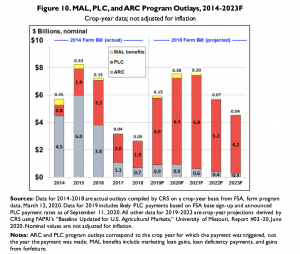
A report last month from the Congressional Research Service (CRS), "U.S. Subcontract Policy: Revenue Support Program Outlays, 2014-2020," stated that, "Provisions of Title I of the 2018 subcontract neb (Agriculture Improvement Act of 2018; P.50. 115-334) authorize a ready of revenue support programs for major plan crops for ingather years 2019-2023 equally part of the and then-called farm prophylactic net. This includes three master revenue support programs— Marketing Assistance Loan (MAL), Agricultural Risk Coverage (ARC), and Price Loss Coverage (PLC)."
The CRS update noted that, "The ARC and PLC programs were start authorized under the 2014 farm neb (Agricultural Human action of 2014; P.Fifty. 113-79) for the ingather years 2014-2018. At the commencement of the 2014 subcontract bill, participating producers were offered a one-time opportunity to enroll their historical plan acres (referred to as "base of operations"acres), on a crop-by-crop footing, for either ARC or PLC."
"Under the 2014 sign- up, producers enrolled 260 meg base of operations acres for 20 covered commodities. The iii largest crops in terms of base acres—corn, soybeans, and wheat—accounted for 83% of enrolled base acres," the report said.
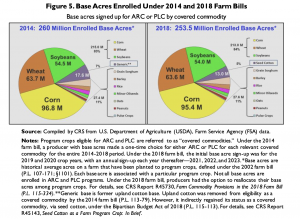
Last month's report explained that, "Under the 2019 sign-upwards and reallocation, producers enrolled 253.5 million base of operations acres in ARC and PLC—a refuse of half-dozen.5 one thousand thousand acres from the 2014 enrollment. A large portion of the difference in base acres was the result of the reassignment of generic base acres. Generic base acres were created in 2014 when upland cotton was removed from eligibility for ARC and PLC payments. In 2018, when the Bipartisan Upkeep Understanding (P.L. 115-123) added seed cotton as a covered commodity, generic base acres needed to be either assigned to a covered commodity or eliminated. Of the 17.6 one thousand thousand acres of former generic base, 13 million were reallocated to seed cotton fiber with the remainder either enrolling nether other covered commodities or dropping out of participation—likely accounting for a substantial portion of the decline in total enrolled base acres. The share of total base of operations acres for the acme three crops—corn, soybeans, and wheat—increased from 83% to 84%."
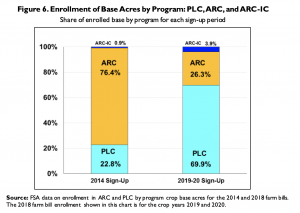
"Nether the 2014 subcontract bill, most base acres (76.4%) were enrolled in the county-level ARC programme, compared with 22.8% base acres enrolled in PLC," the report said; adding that, "Total ARC participation fell from 76.4% under the 2014 sign-up to 26.3% nether the 2019-2020 sign-up, while PLC participation rose from 22.8% to 69.9%."
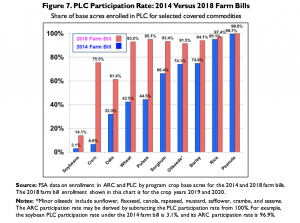
"The high enrollment share for ARC under the 2014 sign-up for corn, soybeans, and wheat was due to their high farm prices during the 2010-2013 menstruation," the report said.
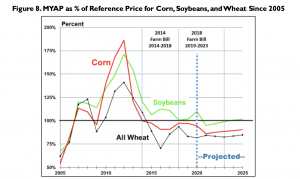
Nevertheless, "Past 2017, declining MYAPs [ market place-yr average farm price] from the 2014-2016 period had dampened the cost component of the ARC revenue guarantee and reduced ARC payments in 2017 and 2018."
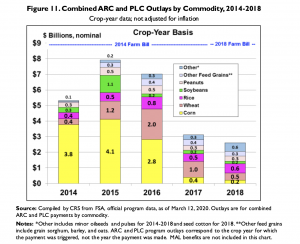
With respect to outlays by article, CRS pointed out that, "During the 2014 farm bill's v-year period, corn accounted for $11.3 billion (or 44%) of total combined ARC and PLC payments. Wheat accounted for $5.0 billion (nineteen%), rice for $2.eight billion (eleven%), soybeans for $2.0 billion (eight%), peanuts for $2.0 billion (8%), other feed grains for $1.5 billion (6%), and the residuum for $i.4 billion (5%). However, the payments were not evenly distributed over time—most of the payments to corn base acres came during the first three years of the 2014 farm neb (2014-2016), when corn received $10.7 billion in combined ARC and PLC outlays."
CRS noted that its study "is a starting point for a word of how well the MAL, ARC, and PLC programs have performed as farm safety net programs. It is intended to provide some context for time to come congressional consideration of farm policy, particularly in calorie-free of the substantial volume of ad hoc subcontract support payments that have been paid out in recent years, which are contained of farm-bill-authorized farm safety net programs.
During the past three years (2018-2020), USDA has been expected to pay as much as $39 billion over and above the farm bill'due south traditional back up through MAL, ARC, and PLC, including $8.6 billion under the 2018 Marketplace Facilitation Payment program, $14.5 billion nether the 2019 Market Facilitation Payment program, and potentially $xvi billion nether the 2020 Coronavirus Food Assistance Program.
"This is in comparing to an estimated $11.5 billion in MAL, ARC, and PLC payments over the same 2018-2020 catamenia."


What Is The Farm Bill Congressional Research Service,
Source: https://farmpolicynews.illinois.edu/2020/11/crs-report-farm-bill-revenue-support-2014-2020/
Posted by: lukensorms1986.blogspot.com
0 Response to "What Is The Farm Bill Congressional Research Service"
Post a Comment